



Own Less, Wear More: The Philosophy Behind Nadbrad Multiwear Clothing

Please Do NOT Buy From Me
I'd like to share a story that explains a few things you should know before you look any further at the clothing we make here at Nadbrad.
Once upon a time — the other day — I was working in the popup Nadbrad shop at a busy local market. During a short lull in visitors, I overheard a conversation in the booth next to me.
The shopper had given one of those lines that all vendors have heard — what I call the “let me down easy” lines. They're the little excuses we give when leaving a shop without purchasing something.

Things like:
“I'll be back after I do a full round of the market.”
“If it's still here later then I will.”
Or in this case:
“Oh if only it was in a different colour then I definitely would.”
What caught my attention was what came next.
The lovely young girl working in the booth smiled and said:
“I know you're not going to buy anything because that was one of those let-me-down-easy excuses, but I'm going to give you my spiel anyway because you're only going to purchase something that really calls to you. Maybe there's something else here you haven't noticed yet.”
The lady laughed and agreed to listen. She added:
“Well, I guess it's your job to get me to buy something, so go ahead.”
The girl proceeded with her pitch. The shopper thanked her for the information and left without finding anything that called to her.
An innocent enough interaction, yes.
But something about it had me all worked up.
“I guess it's your job to get me to buy something.”
That sentence rang in my ears all week. Eventually I sat with it and wondered why it had gotten me so stuck in this mental loop.
I mean, let's face it — what she said was kind of true, isn't it?
We vendors are out there working hard, selling our wares.
But is it actually our job to sell?
I hope not, because if that's the case then I might be the worst salesperson I could ever hire.
The truth is, there are a lot of times when I actually don't want people to buy my garments, and I'll tell you why.
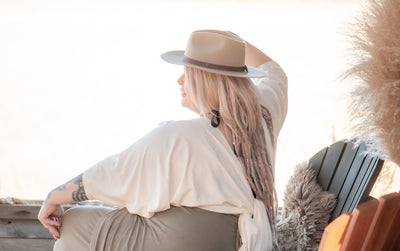
As you may already know, I hand-make clothing that can be worn in several different styles. There are plenty of great details that make these pieces special — soft sustainable fabrics, low-waste production, handmade locally, multiwearable designs that fit a wide range of bodies.
But I want to go a little deeper, because it really matters.
To understand why I don't want everyone to buy these clothes, we first have to answer a different question:
Why do I make them in the first place?

Why these designs?
Why handmade?
Why these fabrics?
Why do things the way I do them?
The rawest answer is that I don't feel like I have much choice. There is something inside of me that pushes me to live my life as authentically and ethically as possible, and to infuse my values into everything I do.
One of those values is sustainability.
To me, sustainability comes down to a simple question:
Can we keep living like this, or are we draining our buckets?
With systems built around constant consumption and economic growth.
With the quick “fill that emotional void” mentality we've been conditioned to see as normal.
With a head-down focus that often ignores the impacts on other people, the planet, and even our own mind, body, and energy.
For me, the answer is no.
The way our society currently operates doesn't feel sustainable. I see it in the cost of living, in the rubbish floating in the oceans, and in the mental health struggles of myself and so many people I know.
But I'm also a realist. Change is hard, uncomfortable, and often slow.
So instead of trying to escape the system completely, I started asking a different question:
How can I bend the rules a little and tip the scale in a better direction?
Here's a simple example.
Consumerism as a whole is weighted toward being unsustainable. There is more energy output than energy produced. Consuming less helps — less waste, less impact, less money spent.
But the human side of that equation is real too. Consuming less can feel like fewer options, less freedom, maybe even a sense of lack.
So my goal is always the same:
How can I tip that scale toward balance?
That's where multiwear clothing comes in.
Instead of owning ten different garments for ten different looks, one piece can transform into many styles. The same garment can show up differently depending on how you wear it.
It allows you to own fewer clothes while still having options.

More possibility.
Less consumption.
It's one small way of tipping the sustainability scale in a positive direction.
And there are so many ways we can each do that in our lives.
Have you found your own ways of living more sustainably? Any creative ideas you'd like to share?
Because while we can't change the world with just one shift, we do move closer with every conscious step.
And that matters.
So now that I've shared one reason why I do what I do, my stance on not wanting to sell to everyone might not be such a surprise.
When people hear me say that I actually don't want everyone to buy my garments — and see me talking people out of purchases when they seem unsure — they often get confused.
Why wouldn't I want to sell my work?
The answer isn't as simple as saying, “because they're not for everyone.”
It's tied directly to my core values: sustainability, authenticity, and ethics.
There are many ways to tip the sustainability scale, and I can only offer one tool. What happens next is up to the person using it.
If someone buys a piece designed to help them get more out of less, but it ends up sitting unworn in the back of a closet, then it has actually had the opposite effect.
In that case, selling it wasn't a success.
My job isn't to sell you a Tulu.
My job is to see whether a Tulu is actually a good match for you.
Maybe you could say I'm more of a matchmaker than a salesperson.
That doesn't mean the garments have to be worn in every possible style. They don't need to be used in a particular way.
What matters is that they give more energy than they take — by being worn, enjoyed, and bringing something positive into your life.
There are also many other pieces to the sustainability equation we haven't even touched on yet:
The materials used.
The hands that make them.
The number of garments produced.
How you feel when you wear them.
What creative expression or healing might happen when you play with how they can be styled.
All of these things matter.
And the more of them I can consider when I create, the more I can help tip that scale for others over time.
And that is why I don't want everyone to buy these clothes.
But…
If you're going to wear them.
Enjoy them.
Feel good in them.
Then I think we may have just found a match!




Leave a comment